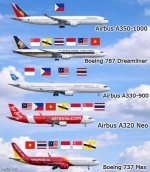
Most Modern Commercial Aircrafts in Southeast Asia


2025
**1.) Airbus 350-1000**
The A350-1000 is the largest and most advanced member of the A350 family, featuring several technological and design firsts for the region:
* **Regional First:** PAL is the inaugural operator of the A350-1000 in Southeast Asia, ahead of major regional competitors.
* **Next-Gen Cabin Design:**
* **Business Class:** Features **Collins Aerospace Elevation** suites with sliding privacy doors and direct aisle access for all 42 seats.
* **Premium Economy & Economy:** Equipped with **Collins Aerospace MiQ** seats. Economy seats offer a generous 6-inch recline and personal mobile device stands.
* **Advanced Entertainment:** Passengers have access to high-definition **4K entertainment screens**.
* **Enhanced Wellness:** The cabin is designed to reduce jet lag through higher humidity levels, lower cabin altitude, and an advanced air filtration system. It is touted as being up to four times quieter than older widebody models.
* **Operational Efficiency:** Powered by **Rolls-Royce Trent XWB-97** engines, the aircraft reduces fuel burn and CO2 emissions by up to 25% compared to previous-generation jets.
* **Ultra-Long-Range Capability:** With a range of up to **16,100 kilometers**, it enables nonstop flights from Manila to major North American cities like New York and Toronto without the need for technical stops.
**2.)** **Boeing 787 Dreamliner**
The Boeing 787 Dreamliner is advanced due to its extensive use of lightweight composites (50% by weight) for better fuel efficiency, advanced aerodynamics, powerful new engines, and "more-electric" systems, all enabling longer, more flexible routes with lower costs and significant passenger comfort enhancements like larger dimmable windows, higher humidity, and a lower cabin altitude for a fresher, quieter ride, making it ideal for connecting Asia's growing markets.
**Key Features & Benefits:**
* **Composite Materials:** The fuselage and wings are primarily carbon fiber, making the aircraft lighter, stronger, more durable (resisting corrosion/fatigue), and significantly more fuel-efficient (25% less fuel than older planes).
* **Fuel Efficiency & Range:** Lighter weight, advanced aerodynamics (like raked wingtips), and efficient engines (GEnx, Trent 1000) allow for longer non-stop flights, opening new routes and reducing operating costs for Southeast Asian carriers.
* **Passenger Comfort:** Larger windows (electronically dimmable), higher cabin humidity, and a lower cabin altitude (closer to sea level) reduce fatigue, creating a noticeably more pleasant long-haul experience.
* **Quieter Cabin:** Modern engines and design reduce noise, benefiting passengers and reducing airport noise pollution.
* **"More Electric" Systems:** Reduces reliance on pneumatic systems, improving efficiency and reliability.
**Relevance to Southeast Asia:**
* **Route Expansion:** Its long-range capability perfectly suits connecting the growing economies in Southeast Asia (like Singapore, Vietnam, Philippines) to Europe, the Americas, and beyond, opening thinner, profitable long-haul markets.
* **Supply Chain Integration:** The region is becoming part of the Dreamliner's supply chain, with companies like KP Aerospace Vietnam manufacturing major components, boosting local aerospace capabilities.
* **Airline Adoption:** Major carriers like Singapore Airlines (which operates the 787-10) rely on it for long-haul growth, demonstrating its strategic importance in the region's aviation landscape.
**3.)** **Airbus A330-900**
The Airbus A330-900neo is advanced in Southeast Asia due to its game-changing fuel efficiency (25% less fuel/CO2 per seat) from new Trent 7000 engines and Sharklets, offering lower operating costs for airlines like Malaysia Airlines & Vietjet while meeting sustainability goals. Its modern 'Airspace' cabin with 4K screens, Wi-Fi, and wider seats provides a superior passenger experience, while its range supports expanded connectivity across Asia, Europe, and Oceania, making it ideal for growing regional demands.
Key Advanced Features
* **Efficiency & Sustainability:**
* **Trent 7000 Engines:** New-generation engines deliver significant fuel savings and lower emissions.
* **Sharklets:** Advanced wingtip devices reduce drag, contributing to a 25% fuel burn/CO2 reduction per seat vs. older jets.
* **SAF Ready:** Certified for Sustainable Aviation Fuel blends, meeting future environmental goals.
* **Performance & Range:**
* **Versatile:** Efficient on short hops to long-haul routes (up to 7,350nm), perfect for Asia's diverse network.
* **ETOPS Compliant:** Enables long flights over water, connecting SEA to Europe, Oceania, and the Middle East non-stop.
* **Passenger Experience (Airspace Cabin):**
* **Quieter Cabin:** New design and engines mean a more relaxing journey.
* **Modern Amenities:** Often includes larger 4K screens, Wi-Fi, and direct aisle access in Business Class.
* **Comfort:** Spacious cabin allows for wider seats and more legroom.
* **Economic Advantage:**
* **Lowest Seat-Mile Cost:** Helps airlines boost profitability and lower operating costs.
**4.) Airbus A320 Neo**
The Airbus A320neo is advanced in Southeast Asia (and globally) due to its significant fuel savings (up to 20%), reduced emissions, quieter engines, and extended range, achieved through new engines (Pratt & Whitney GTF or CFM LEAP-1A) and aerodynamic improvements like Sharklets, all while offering a more comfortable Airspace cabin, making it ideal for the region's growing, efficiency-focused low-cost carriers like AirAsia and Cebu Pacific.
Key Advancements
* **Fuel Efficiency & Emissions:** New engines and Sharklets (curved wingtips) cut fuel burn by 15-20%, significantly lowering operating costs and CO2 emissions.
* **Noise Reduction:** It produces a 50% smaller noise footprint, making it quieter for airports and communities in densely populated Southeast Asia.
* **Extended Range:** Increased fuel capacity allows for longer flights, opening up new routes within and beyond the region.
* **Airspace Cabin:** Offers passengers more personal space, wider seats, larger overhead bins, and mood lighting for a better experience.
* **Operational Flexibility:** Its efficiency benefits both low-cost carriers (like AirAsia) and traditional airlines, suiting diverse regional demands.
* **Sustainable Aviation Fuel (SAF) Ready:** Can fly with up to 50% SAF blends now and 100% by 2030, supporting regional sustainability goals.
Why It Matters for Southeast Asia
* **High Demand for Short/Medium Haul:** The A320neo excels on the short-to-medium-haul routes common in Southeast Asia (e.g., between major hubs like Singapore, Bangkok, Jakarta, Manila).
* **Cost Savings:** Lower fuel burn directly translates to lower fares and better profitability for airlines in a highly competitive market.
**Environmental Compliance:** Reduced emissions help airlines meet growing environmental regulations and passenger expectations in the region.
**5.) Boeing 737 Max**
The Boeing 737 MAX is considered advanced in Southeast Asia due to its superior fuel efficiency (around 14-20% less fuel burn), advanced LEAP-1B engines, effective Advanced Technology (AT) winglets, reduced noise, longer range, and modernized flight deck, making it ideal for the region's growing low-cost carrier (LCC) market, offering airlines better economics, lower emissions, and the ability to serve new, longer routes, notes Boeing and Flightradar24 Blog.
**Key Technological Advancements:**
* **CFM LEAP-1B Engines:** These high-bypass turbofan engines significantly cut fuel consumption and emissions, crucial for cost-sensitive Southeast Asian markets.
* **Advanced Technology (AT) Winglets:** These new winglets reduce drag, boosting lift and further saving fuel, according to Boeing.
* **Aerodynamic Improvements:** A redesigned aft body and nacelle integrated with the wing reduce drag, enhancing efficiency, explains Boeing.
* **Quieter Operation:** Modern engine tech lowers the noise footprint by up to 40%.
* **Increased Range:** The MAX can fly farther (over 3,500 nautical miles), enabling airlines to open new routes, notes Boeing.
* **Modern Flight Deck:** Features large, 787-style displays for improved pilot awareness, according to Boeing.
**Why It Matters for Southeast Asia:**
* **LCC Dominance:** Boeing Newsroom notes that Southeast Asia is the world's fastest-growing single-aisle market, driven by low-cost carriers, making fuel efficiency paramount.
* **Network Expansion:** Airlines like Eastar Jet are using the MAX to expand into new markets (e.g., Singapore, Kuala Lumpur).
**Modernization:** The MAX helps airlines replace older, less efficient jets, supporting fleet modernization and growth in the region, says Boeing Newsroom.


 ️
️ The team will regroup in Hanoi on December 23 after a short three-day break.
 AFC U23 ASIAN CUP 2026 – GROUP STAGE SCHEDULE
 Jan 6:
  Jordan
 Kyrgyzstan
 Saudi Arabia
 Road to Asia continues!


 Myanmar sent nearly 1,500 athletes, but came away with just 3 gold medals.

 Asian Games 2026 • Nagoya (Sept 2026)
 Olympics 2028 • Los Angeles (July 2028)